
New Income Tax Slabs in Nepal for FY 2083/84: Old vs New, Compared
Hajir Khata Team
Share this article:
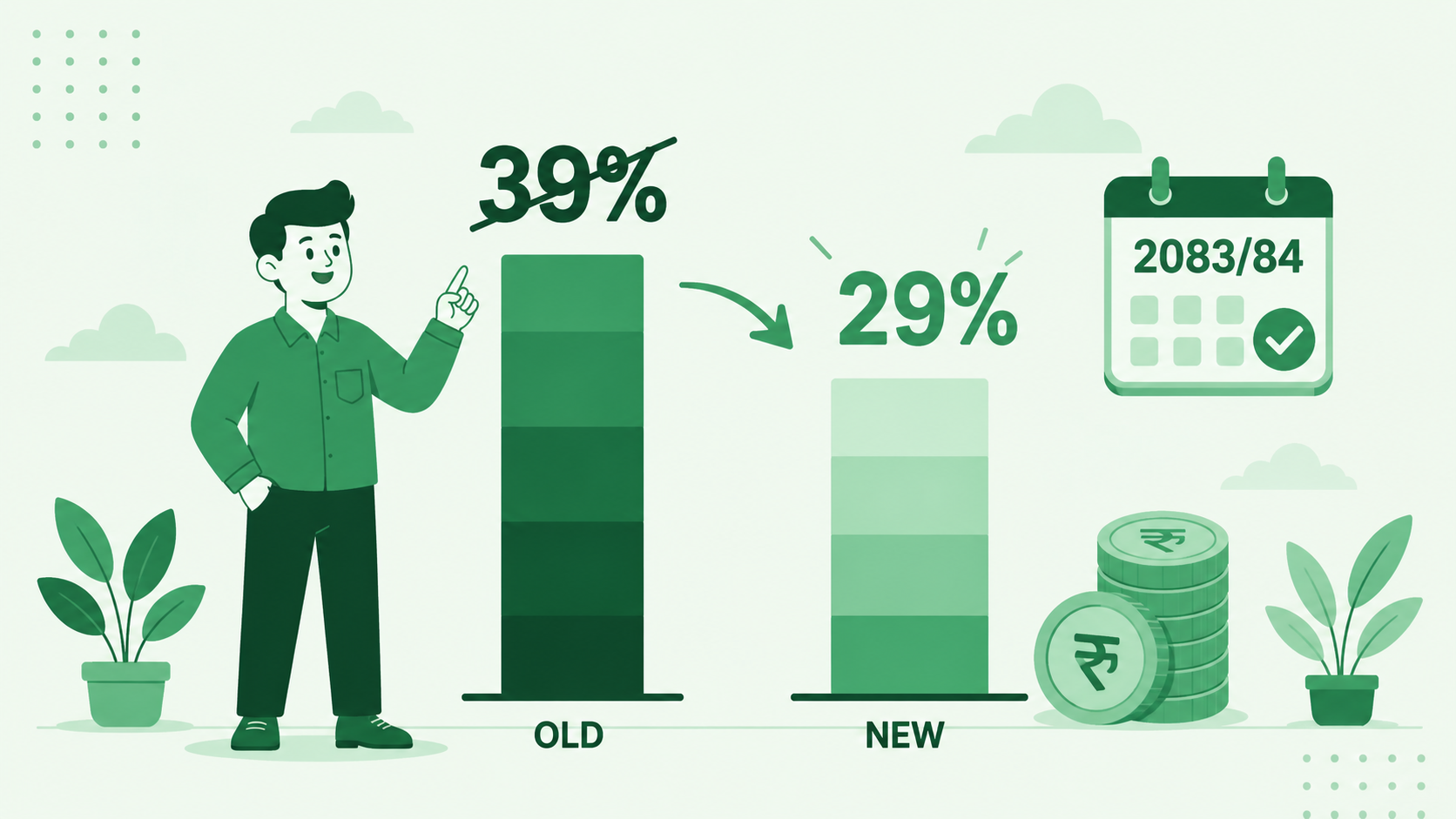
Nepal's individual income tax slabs changed for FY 2083/84, effective Shrawan 1, 2083 (mid-July 2026) — and this isn't a routine annual tweak. The lowest 1% band has doubled in size, the top marginal rate has dropped by a full 10 percentage points, and the old separate slab structure for individuals versus married couples has been scrapped in favor of one uniform table. Any payroll still running FY 2082/83 slabs past Shrawan 1 is calculating TDS wrong on every single payslip.
Old slabs (FY 2082/83)
- Up to NPR 5,00,000 — 1%
- NPR 5,00,001–7,00,000 — 10%
- NPR 7,00,001–10,00,000 — 20%
- NPR 10,00,001–20,00,000 — 30%
- NPR 20,00,001–50,00,000 — 36%
- Above NPR 50,00,000 — 39%
Married couples got a slightly larger first slab (up to NPR 6,00,000 at 1%) — a distinction that no longer exists under the new structure.
New slabs (FY 2083/84)
- Up to NPR 10,00,000 — 1%
- NPR 10,00,001–15,00,000 — 10%
- NPR 15,00,001–25,00,000 — 20%
- NPR 25,00,001–40,00,000 — 27%
- Above NPR 40,00,000 — 29%
The same uniform table now applies to every resident individual, married or not.
What actually changed
- The 1% band doubled — from NPR 5 lakh to NPR 10 lakh, so significantly more income is taxed at the lowest rate before anything higher kicks in
- The top rate dropped from 39% to 29% — a 10-point cut for the highest earners
- Individual and couple slabs merged — one table for everyone, simpler to apply and simpler to explain on a payslip
Who benefits most
Middle-income earners see the clearest gain: someone earning around NPR 12,00,000 a year moves from a 30% marginal band under the old table to a 10% marginal band under the new one. High earners benefit too, just less dramatically in percentage terms, from the lower ceiling rate.
What this means for payroll
Every TDS calculation from Shrawan 1, 2083 onward needs to run on the new table, not the old one — mid-year transitions like this are exactly where manual payroll and stale spreadsheet formulas fall behind. Hajir Khata applies the current slab table automatically to every payroll run, so a rate change like this updates once at the source instead of once per spreadsheet.
Tax slabs are set by the Government of Nepal's annual Finance Act and can be revised; always confirm current rates against the latest Inland Revenue Department notice before relying on any figure for compliance purposes.
Ready to streamline your attendance and payroll processes?
Discover how Hajir-Khata can help your business save time and reduce errors.