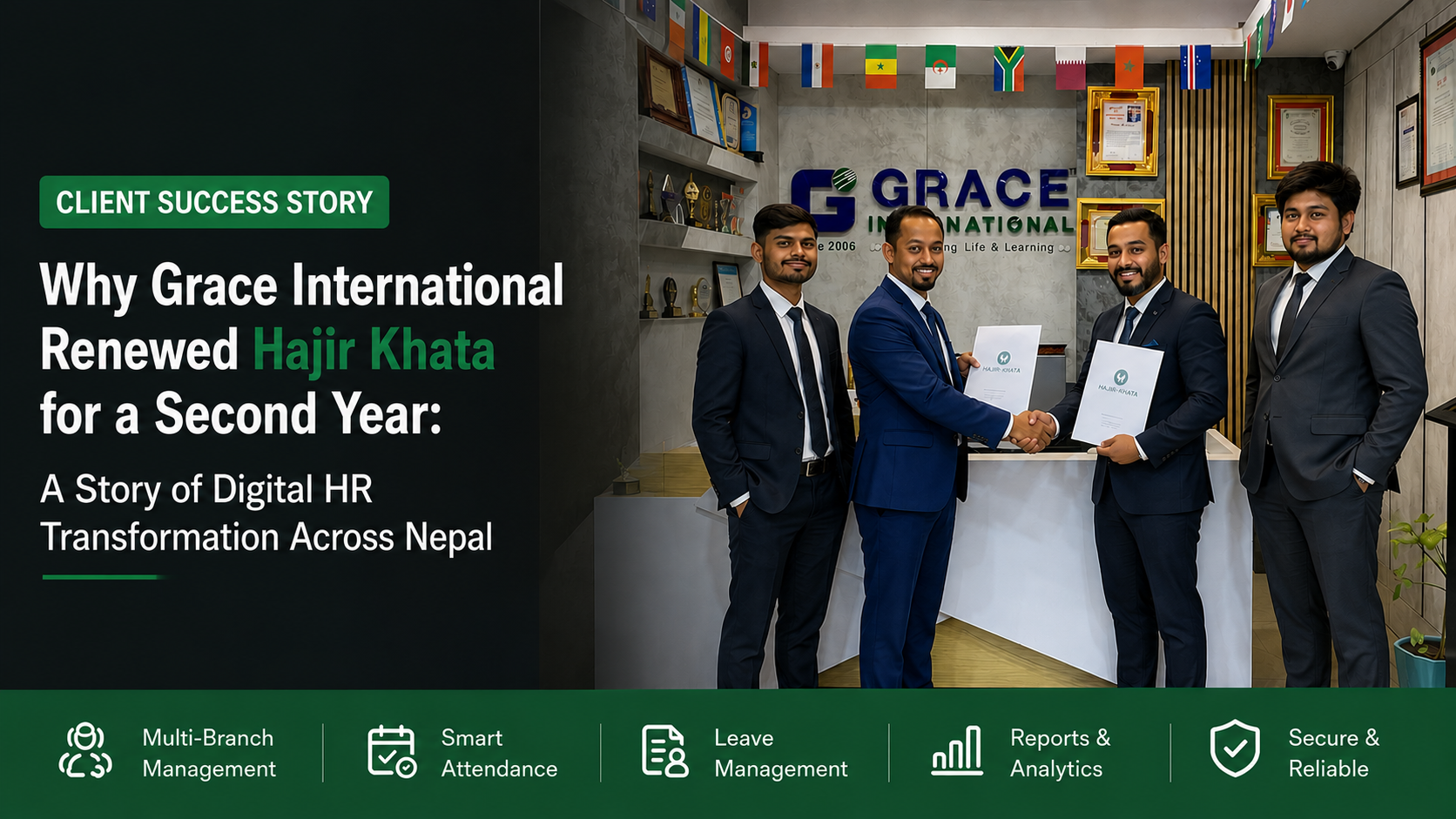
Why Grace International Renewed Hajir Khata for a Second Year: A Story of Digital HR Transformation Across Nepal
Hajir Khata Team
Share this article:
When organizations renew software subscriptions, most people assume it is a routine administrative task.
In reality, renewals are one of the strongest indicators of whether a software solution is creating real value.
After all, acquiring a customer is easy compared to earning their trust for another year.
That is why we are proud to share that Grace International has renewed its partnership with Hajir Khata HRMS for a second consecutive year.
But this story is about much more than a contract renewal.
It is about how one of Nepal's leading educational consultancy organizations embraced modern HR technology to streamline workforce management across multiple branches and why more organizations throughout Nepal are making the same transition.
Trust That Started Before Hajir Khata Became What It Is Today
Every software company talks about innovation.
Few talk about the early days.
When Grace International first partnered with Hajir Khata, our platform looked very different from what it is today.
Many of the advanced features our clients use today did not exist yet.
The product was still evolving.
Features were being refined.
Processes were being optimized.
Like any growing technology company, we were continuously learning from real-world business challenges.
Yet despite being an early version of the platform, Grace International chose to trust us.
They believed in the vision of creating a modern Nepali HRMS built specifically for Nepali organizations.
Over the years, that trust became a partnership.
Their feedback helped us improve.
Their operational challenges helped us innovate.
And together, we built solutions that addressed real HR problems faced by growing organizations.
The Challenge: Managing HR Operations Across Multiple Branches
Organizations with a single office can often manage HR processes manually.
However, as branches expand across different cities, managing employees becomes increasingly complex.
Like many growing organizations in Nepal, Grace International operates through multiple branches and teams spread across different locations.
Managing attendance records, employee information, leave requests, approvals, and workforce reporting across multiple offices can quickly become difficult when systems are disconnected.
Common challenges include:
Different attendance processes across branches
Delayed reporting from regional offices
Difficulty tracking employee records centrally
Time-consuming payroll preparation
Lack of real-time workforce visibility
Dependence on spreadsheets and manual reporting
As organizations grow, these challenges become operational bottlenecks.
The question is no longer whether a company needs HR software.
The question becomes whether the current system can support future growth.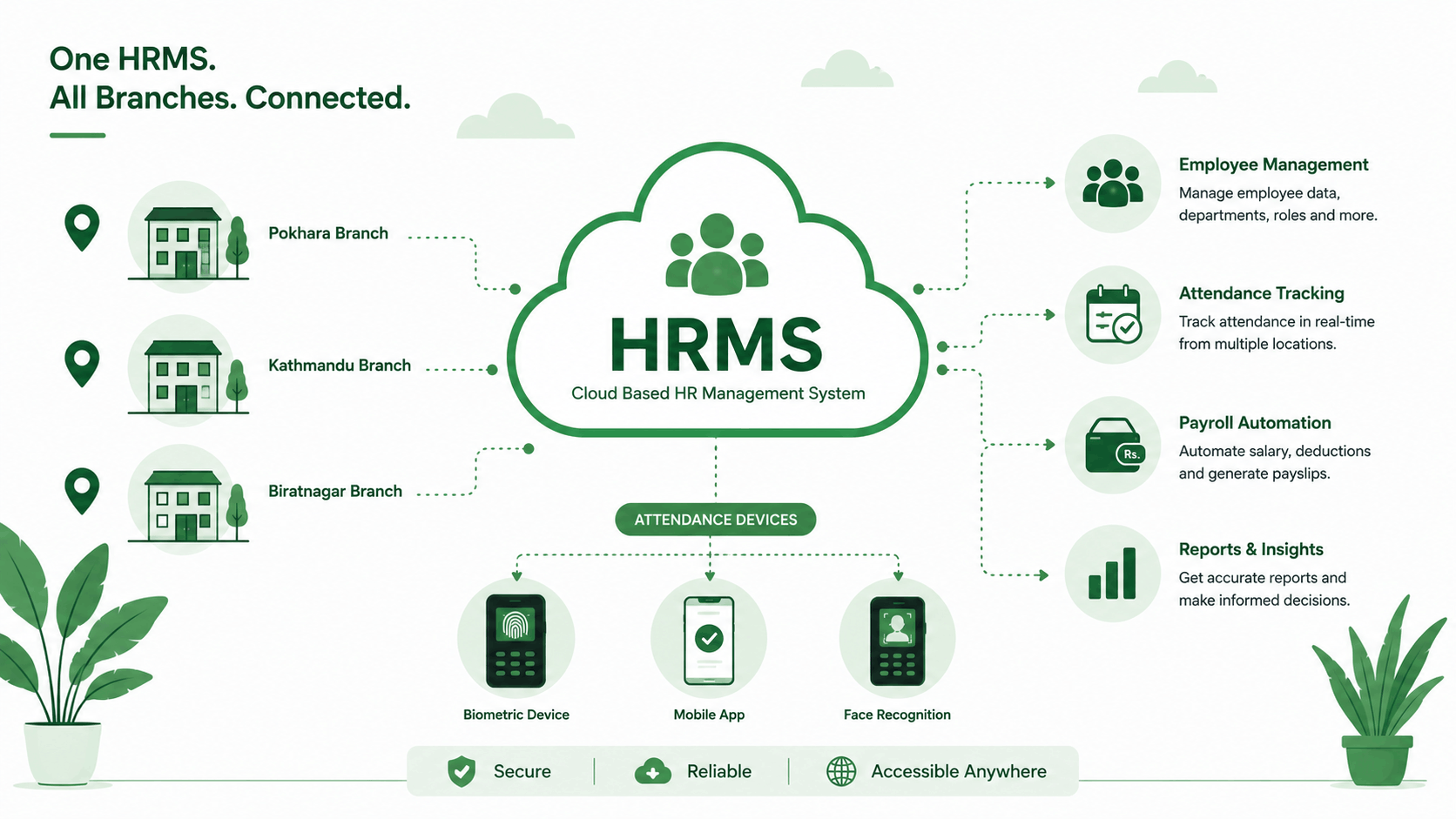
Why Businesses Are Moving Away From Legacy HR Systems
Across Nepal, many organizations still rely on outdated HR software or partially manual processes.
These systems often create more work instead of reducing it.
Common issues include:
Limited Accessibility
Traditional systems are frequently tied to a single office computer or local network.
Managers cannot access workforce information when they are outside the office.
Branch managers often depend on HR personnel for reports and updates.
Data Silos
Employee records, attendance reports, payroll information, and leave records exist in separate systems.
This leads to duplicate work and inconsistent information.
Difficult Branch Management
When organizations operate across multiple locations, legacy systems struggle to provide centralized visibility.
Information becomes fragmented across departments and offices.
Scalability Challenges
What works for 20 employees often fails when an organization grows to 100, 200, or 500 employees.
Growth exposes weaknesses in older systems.
This is one of the major reasons why businesses across Nepal are adopting cloud-based HR software solutions.
Why Grace International Chose to Continue With Hajir Khata
A renewal is not based on promises.
It is based on results.
Over the past year, Grace International experienced firsthand how a centralized HRMS can simplify workforce management.
With Hajir Khata, they gained access to:
Centralized Employee Management
Employee information can be maintained from a single system instead of multiple files and spreadsheets.
Attendance Monitoring Across Branches
Management can view attendance records from different locations without waiting for manual reports.
Digital Leave Management
Leave requests and approvals become faster and more transparent.
Improved Workforce Visibility
Decision-makers gain access to real-time information rather than relying on delayed reports.
A Platform That Continues To Improve
One of the biggest advantages of cloud software is continuous improvement.
Unlike traditional software that remains unchanged for years, cloud platforms evolve regularly through updates, security improvements, and new features.
This was particularly important because Grace International initially joined us when Hajir Khata was still in its earlier stages.
Today, they are benefiting from a significantly more advanced platform built through years of client feedback and product development.
The Rise of Cloud-Based HR Software in Nepal
The shift happening at Grace International is not unique.
Organizations throughout Nepal are moving toward cloud-based HRMS platforms because the modern workplace demands flexibility, accessibility, and real-time information.
Cloud HR software enables businesses to:
Manage employees from anywhere
Access data securely online
Reduce paperwork
Automate repetitive HR tasks
Improve reporting accuracy
Scale easily as the organization grows
This transformation is changing how HR departments operate across Nepal.
What Businesses Should Look For in an HRMS
When selecting HR software in Nepal, organizations should evaluate more than just features.
They should look for a platform that can grow alongside their business.
Important considerations include:
Multi-Branch Capability
Can the software support multiple offices and locations?
Attendance Integration
Does it work with biometric devices and mobile attendance systems?
Payroll Automation
Can payroll calculations be generated accurately and efficiently?
Employee Self-Service
Can employees access their own attendance, leave balances, and documents?
Local Support
Will the provider understand Nepal's business environment and provide timely support?
Future Development
Is the platform actively improving or has development stalled?
Why the Future of HR in Nepal Is Cloud-First
The future of workforce management is not manual paperwork.
It is not spreadsheets emailed between branches.
And it is not outdated software installed on a single office computer.
The future is cloud-based, connected, and accessible from anywhere.
Organizations that embrace this transition gain:
Better operational efficiency
Improved employee experience
Faster decision-making
Greater transparency
Reduced administrative workload
Most importantly, they create systems that can support growth.
Thank You, Grace International
Every successful software company is built by customers who believe in its vision.
Grace International has been one of those organizations.
They trusted Hajir Khata when we were still growing.
They challenged us to improve.
They provided valuable feedback.
And today, they continue to place their confidence in our platform by renewing for another year.
We are grateful for that trust.
As we continue enhancing Hajir Khata HRMS, our commitment remains the same:
To help organizations across Nepal manage attendance, payroll, employee records, leave, and workforce operations through one powerful cloud-based HRMS platform.
If your organization is still relying on spreadsheets, disconnected systems, or outdated HR software, perhaps it is time to explore what modern HR management can look like.
Because the future of HR in Nepal is already here.
Ready to streamline your attendance and payroll processes?
Discover how Hajir-Khata can help your business save time and reduce errors.